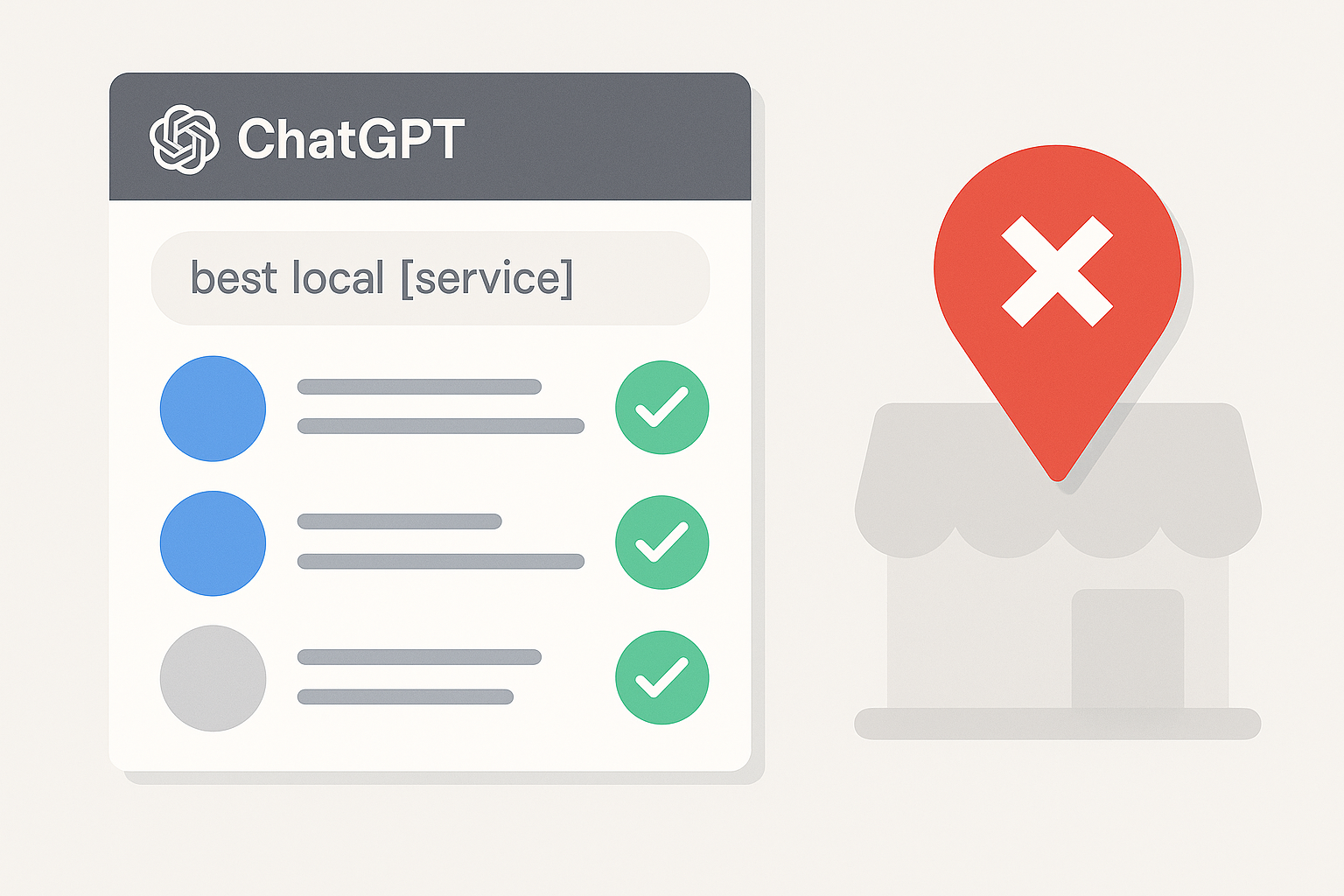
Think Google is still the only place people look for your business?
Think again.
In 2025, tools like ChatGPT, Gemini, and Perplexity are quickly becoming the go-to for business discovery.
And here’s the kicker:
They’re not just showing websites — they’re generating answers.
If your business isn’t showing up in those answers, your competitor already is.
So why is ChatGPT recommending them… and not you?
It comes down to one thing:
AI can only recommend what it’s been trained to trust.
If your listings, website content, and online signals are outdated or inconsistent, these AI tools won’t mention you at all.
You’ll be invisible — no matter how good your business is.ç
What’s Changed
Search isn’t just “search” anymore
If you’re still thinking in terms of Google rankings alone, you’re missing half the picture.
People are now asking questions, not typing keywords — and AI is answering.
Here’s what’s different:
ChatGPT, Gemini, and Perplexity are replacing Google for discovery
AI tools summarize, not rank — they pull from business listings, reviews, and structured content
If your data is outdated or missing, you get skipped, even if your SEO is solid
And this isn’t fringe behavior — it’s mainstream.
Key Stats from Research
43% of U.S. adults use AI tools to research or discover services Source: PEW Research
60% of people say they trust AI summaries more than traditional websites when comparing businesses
Over 80% of users rely on tools like ChatGPT, Claude, Gemini, or Perplexity for research and recommendations Source: Exploding Topics
In other words: Your future customers are asking AI who to hire — not Googling it.
AI tools like ChatGPT and Gemini now dominate local discovery — with traditional Google search declining in influence.
Visibility Gap: You’re Not Training the AI
(So It’s Recommending Someone Else)
Most businesses are doing “okay” on Google — but that’s not the issue anymore.
Symptoms You’re Getting Skipped
You rank on Google, but ChatGPT or Gemini doesn’t mention you
Your listings say one thing, but your site or reviews say another
When someone types “best [your service] in [your city],” your competitor shows up — you don’t
Real Example
Someone asks ChatGPT:
“Who’s the best wedding photographer in Charlotte?”
It replies:
“You might consider Shine Weddings, Lightbox Studios, or EverAfter Snaps.”
If your name’s not in that list, you’re invisible to that buyer — even if you’ve got better reviews and a stronger site.
Consequences of the Gap
Missed referrals from AI summaries
Lower click-through from tools that now integrate AI into search
Lost trust from inconsistencies (AI tools surface mismatched info as red flags)
You don’t need better SEO — you need to feed the AI the right data.
🧠 How AI Tools Recommend Businesses
1. AI scans the web for business data (listings, reviews, schema)
2. AI summarizes the info to match the user’s question
3. If your business info is accurate + consistent, you get recommended
4. If your info is missing, outdated, or vague — you get skipped
Flow of how tools like ChatGPT and Gemini decide which businesses to recommend — and which ones to leave out.
Train the AI to Recommend You
AI tools don’t find you by accident — they’re scraping and summarizing from structured data across dozens of places. Here’s how to get in their line of sight.
1. Audit Your Listings & Profiles
AI tools check your Google Business Profile, Yelp, Bing, Apple Maps, Facebook, and niche directories.
Make sure your Name, Address, Phone (NAP) are consistent
Align your services and hours everywhere
Respond to recent reviews — it’s a signal of trust and activity
2. Add Structured Data to Your Website
Use schema markup to give AI the context it needs:
Local Business schema (Name, Address, Phone, Services)
Review schema (aggregate rating, total count)
FAQ schema (for Q&A-style answers AI can pull directly)
This helps ChatGPT and Gemini understand what you do — and that you’re legit.
3. Create AI-Friendly Content
You’re not just writing for people — you’re writing for machines that summarize. So:
Use questions as headers (H2/H3): “What’s the best HVAC company in [City]?”
Answer clearly in 1–2 sentences, benefit-first
Build out an FAQ or blog series that covers real customer search phrases
4. Use a Listing Sync Tool (Yext or Soar Portal)
Manually syncing 50+ platforms? 😵 No thanks.
Tools like Yext or our own Soar Portal push your info everywhere in one place
They keep listings consistent and updated — the #1 trust factor for AI visibility
✅ How to Train ChatGPT to Recognize Your Business
•Sync your listings across Google, Yelp, Facebook, and local directories
•Add schema markup (LocalBusiness, FAQs, Reviews) to your site
•Use natural Q&A-style content to answer real search questions
•Use Yext, Soar Portal, or a trusted tool to keep data fresh and visible
A simple checklist to make sure ChatGPT and AI tools recognize, summarize, and recommend your business.
New Rules
AI discovery is the new SEO battlefield — and it doesn’t care if your site is pretty.
If you’re not in the data, you’re not in the results. AI tools can’t recommend what they don’t see.
Structured, accurate, and consistent information wins — across listings, schema, and content.
You don’t need to “rank” like it’s 2015. You need to be summarized clearly by AI tools — and trusted by users.
The bottom line? If AI can’t “see” you, neither will your next customer.